
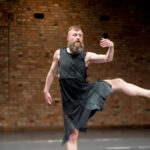
April 9–12. Six solos by Frédéric Gies
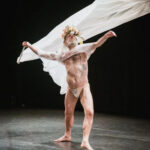
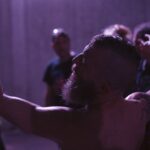
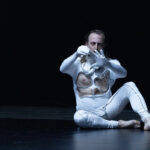
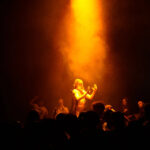
It has been ten years since Frédéric Gies performed his marathon solo Dance is Ancient at Weld – but it feels like yesterday. Since then, Gies has created a series of choreographies never before seen here: his collaboration with Manuel Pelmus, a tribute to Kurt Jooss’s classic The Green Table, and several solos that have toured both in Sweden and internationally – works we have long wished to present. Now we are bringing together five of these solos and concluding with the premiere of the new choreography Dans (Sverige) – solo template version.
April 9
at 7pm Tribute to Kurt Jooss’ Green Table (2025)
at 7.45pm Deflecting Misfortune and Averting the Evil Eye (2024)
April 10 at 7pm
Tribute – Solo version (2020)
April 11
at 7pm Walk+Talk (2017)
at 8.05pm Shadowboxing (2022)
April 12 at 5pm
Dans (Sverige) – solo template version (premiär)
Weld
Norrtullsgatan 7
Book at: book.weld.se
TRIBUTE TO KURT JOOSS’ GREEN TABLE (2025)
Manuel Pelmuș and Frédéric Gies revisit Kurt Jooss’s seminal antiwar ballet The Green Table (1932) on the futility of diplomacy in the face of fascism and war. Their tribute—performed as a solo by Gies in reference to Jooss’s original concept—enters into a critical dialogue with the piece, engaging with its choreographic vocabulary and political urgency. The tradition of the danse macabre, where Death dances with members of all classes, plays a central role in this. Pelmuș and Gies address today’s fractured global order, where peace negotiations often serve as performances of control rather than paths to resolution.
Concept & choreography: Frédéric Gies & Manuel Pelmuș
Performance: Frédéric Gies
Music: Fiedel
Lighting design: Thomas Zamolo
Costume: Grzegorz Matlag
Commissioned and produced by steirischer herbst 2025
With the kind support of ERSTE Foundation and Office for Contemporary Art Norway (OCA)
Deflecting Misfortune and Averting the Evil Eye (2024)
Deflecting Misfortune and Averting the Evil Eye proposes to translate the anasyrma, the ancient ritualistic practice of exposing one’s buttocks or genitals into a dance. The anasyrma, linked to various ancient religious cults, is a practice that fulfills a protective magic function. This practice has also been appropriated by diverse contemporary forms of protest. Paying tribute to various dance or feminist performances, the performance puts to the forefront the relationship between the poetic and the political.
Choreography & dance: Frédéric Gies
Music: Fiedel
Costume: Grzegorz Matlag
Premiered in the frame of Maison de la Danse in Malmö on May 4, 2024.
Also presented at MARC, Brådjupa Festival and in a double bill with Ania Nowak at Maison de la Danse.
With the support of Kulturrådet, Malmö Stad and Region Skåne.
Tribute – Solo version (2020)
Tribute – Solo version was created in November 2020 at the festival Moving in November in Helsinki. It was created and presented as a substitute for the original version of Tribute, created for Weld Company, as the pandemic didn’t allow the company to travel to the festival.
Many dancers dance in a dancer’s body and a dance is always the product of other dances as well as a call for dances to come. For Tribute, Frédéric Gies open his library to make dances that summon up the poetic, delicate and raw textures of past dances, utterly present as the promise of dances to come.
As I started to imagine what could be the dance piece I would make for a dance company that is “aiming to rediscover and revaluate the old institution of Dance Company”, personal memories of dances I witnessed came flooding back. Each of them is closely tied to a dancer whom I saw in the darkness of the dance floor or from my seat at the theatre. These memories, more than mere images, reappear as an imprint in my body. They are also constitutive of my dances. They are my library. / Frédéric Gies
Choreography: Frédéric Gies
Light design: Thomas Zamolo
DJ: Fiedel
Dance:Frédéric Gies
walk+talk (2017)
walk+talk is a lecture performance series initiated by the Austrian choreographer and dancer Philipp Gehmacher in 2008. In walk+talks choreographers are invited to create a solo work that makes the moving and talking run parallel. The topic is the artists’ concepts, the individual understanding of their body-in-motion and the history of their practice. Over twenty artists have participated in five editions of the project that have taken place in Vienna, Brussels, Stockholm, Reykyavik, Berlin and Poznań by far.
Dance: Frédéric Gies
Text: Frédéric Gies
Coaching: Philipp Gehmacher
Produced by: Art Stations Foundation by Grażyna Kulczyk
The 2013 version was created in December 2013 at Kulturhuset in Stockholm. The 2017 version was created on June 23, 2017 at Art Stations Foundation in Poznan. Presented also at My Wild Flag Festival (Stockholm), ImPulsTanz – Vienna International Dance Festival, Ujazdowski Castle Center for Contemporary Art (Warsaw), DOCK11 (Berlin), Maison de la Danse at Ungdomens Hus (Malmö), Skogen (Göteborg).
Shadowboxing (2022)
With Shadowboxing, Frédéric Gies channels years of research around club dancing as an art form. They break down the barriers between popular and professional dance(s) in this poetic experimentation of a dance floor on a dance floor.
Since 2014 and my encounter with the techno dj and producer Fiedel, techno music is a central element in my pieces. Many of my latest works reference clubs and raves, in the dance itself or in the collective experience to which I invite the spectators. During these years, I have also developed a practice called Technosomatics, which brings together somatic explorations and club dancing. In some of my pieces, I have worked on approaching club dancing in a formal and compositional way.
Shadowboxing takes club dance as a vast field of movement and poetic experimentation and states that this form of dance is way more than just dancing around. Through the dance and the way it is interwoven with the music, various bodies and images take shape. My body becomes the channel for making other characters, creatures and entities temporarily inhabit the dance floor.
Frédéric Gies
Choreography: Frédéric Gies
Dance: Frédéric Gies
Music: Fiedel
Lighting Design: Thomas Zamolo
Costume: Grzegorz Matlag
Photos: Thomas Zamolo and Micaela Blomqvist
Produced by SITE
With the support of Kulturrådet
Dans (Sverige) – solo template version
The premises of this new work lie in two backward movements: looking back into the prolific dance materials of the 35 pieces Gies created since they moved to Sweden twelve years ago and looking back at the few traces left of Maison de Fous (Dårhuset), a 1920 work by Les Ballets Suédois, which can be considered as one of the first manifestations of Modernism in Sweden. While the piece looks into the past and excavates the uncanny kinship between Gies’ work and Maison de Fous, it also takes a sharp look at the present, positioning itself against the fetishization of national origins and making use of the figure of the “Fou” as a subversive, irreverent force destabilizing oppressive power structures.
Choreography and dance: Frédéric Gies
Music: Fiedel
Lighting design: Thomas Zamolo
Costumes: Grzegorz Matlag
Artistic assistance: Elise Brewer
Coproduced by Skogen and Weld
Residence support by MARC and Skogen
With the support of Kulturrådet, Region Skåne, Konstnärsnämnden
FRÉDÉRIC GIES
is a dancer and choreographer. Drawing from their training in ballet, their encounters with specific trends of contemporary dance, their dance floor experiences in techno clubs and raves and their studies of somatic practices, Frédéric Gies approaches form as possibilities rather than constraints. They present their work internationally in dance and music venues and in museums.
→ danceisancient.se
Weld is supported by the City of Stockholm, the Swedish Arts Council and Region Stockholm.